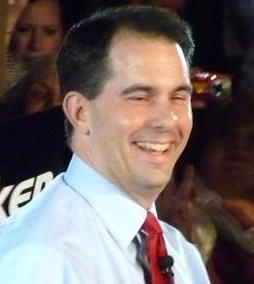
Republicans have been allowing the left to set the terms and terrain for debate over a wide array of issues. The right has continually failed to challenge underlying assumptions and language used by the media, pundits, and politicians on both sides of the aisle. This has allowed, even helped, the left to determine a battleground that is less defensible for the right by presupposing certain facts and language that should be readily open to challenge. The right, for the most part, seems to be oblivious to this fact—an effect that is slowly undermining the philosophy of the right, their political goals, and eventually support for a conservative agenda.
This issue has been painfully present throughout the Wisconsin recall election. Specifically, the debate has been framed as an issue of collective bargaining rights. The Washington Post stated, "The passions that fueled a long fight over union rights and Wisconsin’s cash-strapped budget brought voters out in strong numbers Tuesday to decide whether to recall Gov. Scott Walker [emphasis added]." The New York Times used similar language, "[V]oters began streaming into polling places on Tuesday to decide whether to remove Gov. Scott Walker, the Republican whose decision to cut collective bargaining rights for most public workers set off the fight [emphasis added]." CNN parroted, "Gov. Scott Walker [is] a Republican hero for pushing austerity measures that stripped collective bargaining rights from most public unions [emphasis added]." The supposedly right-leaning Wall Street Journal fell into the same trap: "The recall was triggered by a backlash to a law Mr. Walker signed in March 2011, two months after taking office, that forced government workers to pay for more of their pension and health-care benefits while also cutting most of their collective-bargaining rights [emphasis added]." Even the hated "right-wing propaganda" from Fox News used rights language: "The effort to recall Walker began shortly after he was elected in 2010 and began cutting the state’s huge budget shortfall by holding down taxes and removing collective-bargaining rights for unions representing state employees [emphasis added]."
While at first glance this may seem trivial, the nearly complete use of rights language is packed with assumptions—assumptions that validate the left's political philosophy and make it exceedingly difficult for Republicans to reorient the country's drift. Walker's win was aided by a number of factors—unmanageable state fiscal conditions, distaste with the concept of recall elections, and the poor economy—that may not exist in the future. However, without the presence of these factors, the underlying problem—the pernicious effect of collective bargaining by public sector unions—arguably may not hold electoral sway in future political climates, particularly if the right is unable able to correctly elucidate the issue.
The pervasive use of "rights" language is the crux of the problem. By labeling collective bargaining a right, the left is able to incorrectly frame the debate and mop-up voters who are offered a false understanding of the issues. It leaves the right with a reduced tool-kit to persuade voters, thus handicapping their arguments and their efforts. Republicans have only been able to go after the pernicious effects of public unions during an economic downturn because the employment of rights language has prevented them from successfully arguing against the innate demerits of public sector unions. They have thus been unable to illuminate the problems of collective bargaining absent economic woes, preventing the advancement of a just policy that should be easily supportable even during economic booms. By using the language of the left, the right is providing the unions and the Democrats with a subtle but lasting win. They are allowing collective bargaining to be incorrectly defined in leftist terms, as a right—a concept that is held to be sacred to most Americans and something that people have been striving to protect for generations.
According to the Stanford Encyclopedia of Philosophy right are defined in the following manner:
Rights are entitlements (not) to perform certain actions, or (not) to be in certain states; or entitlements that others (not) perform certain actions or (not) be in certain states.In other words, rights are entitlements that individuals can justly make a claim on. A government that strips its citizens of their rights is unjust and has exceeded its authority. This is a fact that is recognized by most Americans. The United States has a long history of promoting and defending rights. Even if most Americans agree with Governor Walker's policies, by labeling them an attack on collective bargaining rights, many Americans are left with a level of discomfort, an internal cognitive dissonance between a policy that innately feels correct and an attack on an institution that has high value.
Rights dominate modern understandings of what actions are permissible and which institutions are just. Rights structure the form of governments, the content of laws, and the shape of morality as it is currently perceived. To accept a set of rights is to approve a distribution of freedom and authority, and so to endorse a certain view of what may, must, and must not be done.
Such internal dissonance, even if subconscious, yields a substantial win for the left, especially among younger, more idealistic voters. It not only compels some to vote with their "hearts," but generates a space for political arguments that misconstrue the facts. Political battles can be won and lost, but by defining the framework in which battle is conducted, the left wins the long-term war. Through this process the left is able to successfully define how future generations will think.
The problem is fortunately easy to rectify. Republican politicians and pundits must be aware of the language they use and they need to clarify the (often unthinking) misuse of language by the media and other public figures. Collective bargaining rights need to be re-framed as what they truly are: collective bargaining privileges (or more benignly collective bargaining). This will, at minimum move the debate from one over whether it is acceptable to strip certain rights from public sector union members to one over whether these powers are rights or privileges. At best, a complete swing in language will move the battleground to more friendly terrain (and correct terrain in the eyes of this blog) where collective bargaining powers will be justly classified as undue privileges and thus much easier to curtail.[1] (who would stand for giving a special interest privileges at taxpayer expense?)
By changing the framework of debate, Republicans will have an easier time presenting their arguments, putting the Democrats on the defensive, and undercutting the ability for the left to portray such sensible reforms as undermining anyone but a narrow special interest. But if the right is not careful, as has unfortunately been true for decades, the left will continue to win the war of language, thereby slowly undermining the principles of this country.
Note:
[1]Collective bargaining, especially by public sector unions, is unquestionably not a right. Collective or group rights in general are hardly defensible. An understanding of the proper role of government does not leave any space or philosophical justification for such a right. While arguments may be made for the utility of collective bargaining in some instances and at some times (possibly, more so in the private sector with truly commoditized services that lack adequate government protections for labor), they cannot be made in rights language. Other justifications must be employed to defend collective bargaining, which is exceedingly difficult. This is why the left has successfully fought to define many of its political goals over the past decades, in terms of rights language. It is much easier to defend a right (and some in the Civil Rights era were clearly violated) than rely upon another less potent and universal defense. But the abuse of the concept of right has gone too far, and is (and has been) undermining the fabric of the American political system.

